Worried the Clock Has Run Out on Your Investment Losses?
If you are a Miami investor who lost money to broker misconduct, the most urgent question you have is probably whether it is too late to do anything about it. The answer often turns on the finra rule 12206 eligibility rule, which sets a six-year window for bringing a case before an arbitration panel. Understanding this six-year eligibility standard matters, but the biggest mistake investors make is assuming it works like a statute of limitations that automatically kills their claim on a fixed date. It does not, and Miami investors deserve accurate information about their investor rights before writing off a potential recovery. Our team at Kaplan Rothstein Prüss Peraza, P.A helps investors through finra rule 12206 eligibility rule lawyer counsel focused on stockbroker misconduct and investment fraud.
If you have lost money and worry it is too late, our securities lawyers can tell you where you stand. Call us at (888) 578-6255 or reach us through our contact page to have the timing of your potential claim evaluated. We have recovered more than $200M from the world’s largest banks and brokerage firms, including Morgan Stanley, UBS, Merrill Lynch, Wells Fargo, and JP Morgan Chase.
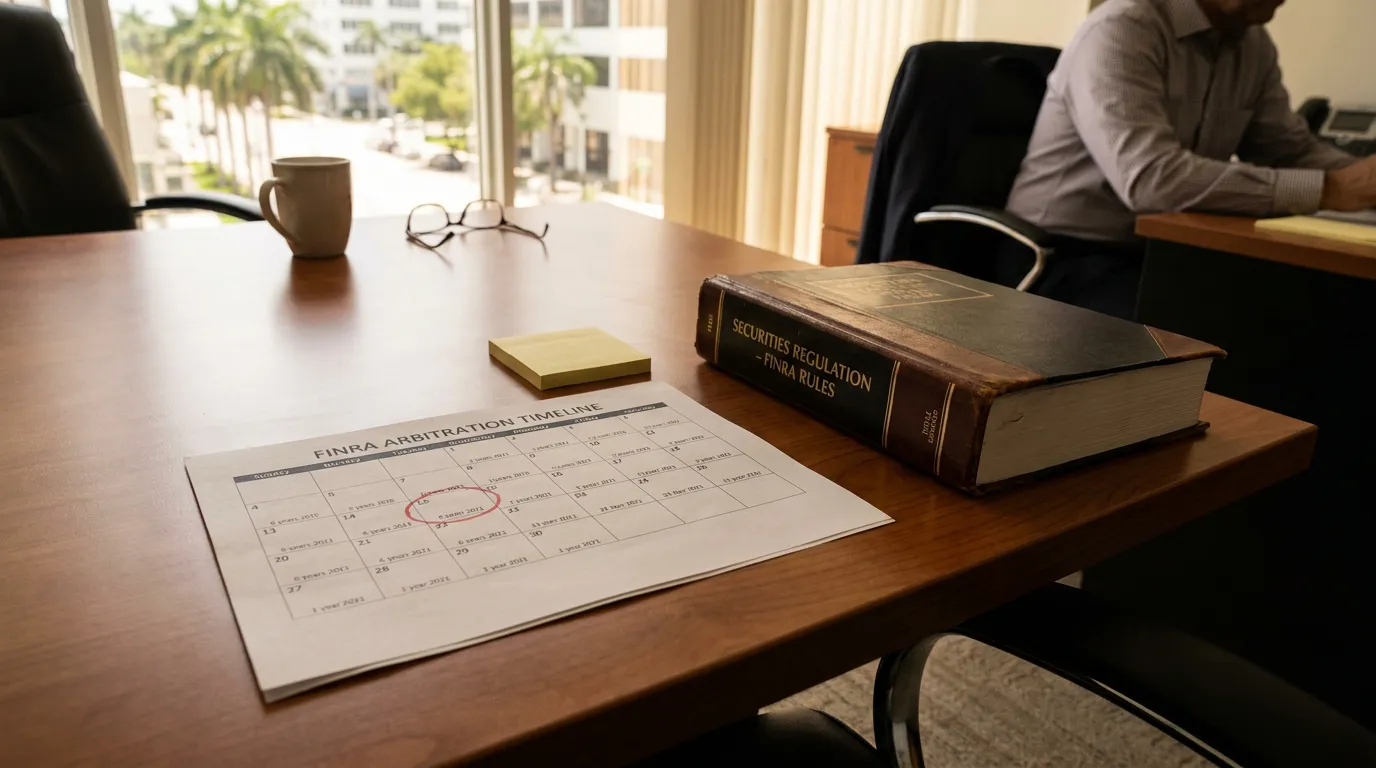
FINRA Rule 12206 Eligibility Rule, Explained in Plain English
FINRA Rule 12206 is an eligibility rule, not a statute of limitations. It provides that no claim can be submitted to FINRA arbitration once six years have passed from the occurrence or event that gave rise to the claim. The arbitration panel, not the brokerage firm, decides whether a claim meets this six-year requirement.
That plain-English summary comes straight from the rule’s core text.
FINRA Rule 12206(a) states that no claim shall be eligible for submission to arbitration under the Code where six years have elapsed from the occurrence or event giving rise to the claim.
Just as importantly, the panel will resolve any questions regarding the eligibility of a claim under this rule.
You can review the official text of Rule 12206 to see the exact language. Because eligibility is decided case by case, a firm’s early claim that your securities claim is stale is an argument, not a verdict.
Is the Six-Year Rule the Same as a Statute of Limitations? (No, and Here Is Why It Matters)
The six-year eligibility rule is a distinct concept from a statute of limitations, and treating them as identical is a costly error. A statute of limitations is a substantive time limit set by legislatures; the eligibility rule is a procedural gatekeeper for one specific forum.
Under FINRA Rule 12206(c), the rule does not extend applicable statutes of limitations, nor does the six-year limit apply to claims directed to arbitration by a court of competent jurisdiction upon a member’s or associated person’s request. Separately, under Rule 12206(d), the six-year time limitation will not run while a court retains jurisdiction of the matter.
These are separate clocks that can run on different tracks.
The second common error is assuming the six-year clock always starts on the day you bought the investment. That is often wrong. The rule ties the deadline to the "occurrence or event giving rise to the claim," which is a factual question. In cases involving churning or a course of unsuitable recommendations over time, the relevant occurrence may not be a single purchase date at all. Because the panel resolves eligibility on the facts, the starting point of your claim deadline is frequently open to argument rather than fixed.
How the 6-Year Clock Affects Miami Investors
For Miami investors, the six-year window applies to the same misconduct patterns that drive most stockbroker negligence cases. Those fact patterns commonly include the following:
- Unsuitable recommendations that ignored your risk tolerance or objectives
- Unauthorized trading in your account without your consent
- Churning, or excessive trading that generates commissions
- Misrepresentations or omissions about a product’s risks
- Improper asset allocation, margin losses, or the sale of fraudulent products
Because a broker dispute often develops slowly, the date the misconduct became apparent may differ from the date it began. That distinction can determine whether your matter is timely. Our firm serves South Florida’s diverse investor community directly, and we are proud that at our office Se Habla Español and Nós Falamos o Português. If you want to understand the forum itself, our overview of FINRA arbitration for Miami investors explains how the process works alongside this eligibility deadline.
💡 Pro Tip: Write down a timeline of every account statement, phone call, and email as soon as you suspect a problem. A clear chronology helps establish when the relevant occurrence or event took place under Rule 12206.
Florida Deadlines and Duties Every Miami Investor Should Know
Florida law adds context that national pages usually ignore, and it can strengthen a Miami investor’s position. FINRA’s rule is national, but Florida securities duties often supply the backdrop for a negligence or misrepresentation claim.
Florida imposes affirmative disclosure duties on those selling securities.
Under Fla. Stat. § 517.0611(8), a disclosure statement must be provided to each prospective investor at least 3 days before the investor’s commitment to purchase or payment of any consideration, and it must contain material information including the issuer’s identity, business plan, use of proceeds, ownership and capital structure, financial condition, and mandatory risk statements. This provision applies to Florida’s limited offering (intrastate crowdfunding) exemption rather than to every securities transaction.
When those disclosures are missing or misleading, that failure can support the underlying misconduct claim.
Florida also arms firms with tools to protect older investors from exploitation.
Under Fla. Stat. § 517.34(4), as amended in 2025, a transaction delay expires 15 business days after being placed, but may be extended for up to 30 additional business days if the firm’s review continues to support a reasonable belief that financial exploitation of a specified adult has occurred, is occurring, has been attempted, or will be attempted, and a court of competent jurisdiction may shorten or extend the delay.
A broker’s disregard of such duties can inform a breach-of-duty claim. You can read these provisions in Florida’s securities code.
Different forums carry different clocks, and one Florida contrast makes the point.
For an administrative complaint against a broker or sales associate in the real estate context, Fla. Stat. § 475.25(5) requires filing within 5 years of the act giving rise to the complaint, or within 5 years of when it is discovered or should have been discovered with due diligence.
That real-estate licensing deadline is not a securities rule, but it illustrates a core principle: the deadline that governs your matter depends on the forum and the type of claim.
What Happens If a Brokerage Firm Says Your Claim Is Time-Barred?
A firm’s assertion that your claim is too old is the beginning of a fight, not the end of your options. Brokerage firms cannot simply declare a matter ineligible whenever they choose.
Motions under Rule 12206(b) must be made in writing, filed separately from the answer, and only after the answer is filed, and the party asserting the claim must have the opportunity to respond before the panel may dismiss.
Those procedural limits restrict how and when a firm can raise the six-year issue.
Even if a panel dismisses a claim as ineligible, that dismissal generally does not extinguish the claim.
Rule 12206(b) provides that dismissal of a claim under this rule does not prohibit a party from pursuing the claim in court.
In other words, the eligibility rule is a bar to the arbitration forum, not automatic proof that your case is worthless. Whether a court path remains available depends on the applicable statutes of limitations and the specific facts, so outcomes vary and courts interpret timing exceptions narrowly.
Why Timing and Records Matter in FINRA Arbitration
Timing matters in FINRA arbitration because the results are difficult to undo.
The SEC states that it cannot overturn or change an arbitration panel’s decision, and arbitration decisions generally are not subject to appeal.
The limited exceptions are narrow.
Under the Federal Arbitration Act, a motion to vacate must be served within three months after the award is filed or delivered, and some states allow even less time.
Because awards are essentially final, preserving your trading records early is critical. Account statements, trade confirmations, correspondence, and notes about broker conversations often make the difference in showing when an occurrence took place and how losses accrued. We have recovered more than $100M for victims of securities fraud and stockbroker misconduct, and strong documentation is central to that work.
Frequently Asked Questions
Is FINRA Rule 12206 the same as a statute of limitations? No. It is an eligibility rule for the arbitration forum.
Rule 12206(c) confirms the rule does not extend applicable statutes of limitations, nor does the six-year limit apply to claims that a court of competent jurisdiction directs to arbitration upon a member’s or associated person’s request.Does the six-year clock start on the day I bought the investment? Not necessarily. The rule measures six years from the occurrence or event giving rise to the claim, and the panel decides that factual question case by case.
If my FINRA claim is dismissed as too old, is my case over? Not automatically. A dismissal under the eligibility rule does not, by itself, prohibit you from pursuing the claim in court, though other deadlines may apply.
How does the six-year rule apply to Miami and Florida investors? The FINRA rule is national and applies the same way in Miami as elsewhere. Florida claims and forums, however, carry their own separate deadlines and duties.
Who decides whether my claim meets the six-year requirement? The arbitration panel does. Because eligibility is fact-dependent, a firm’s early time-bar argument is not the final word.
Don’t Assume It’s Too Late to Recover Your Losses
The finra rule 12206 eligibility rule is a serious deadline, but it is far more nuanced than the "six years from purchase" oversimplification many Miami investors hear. The occurrence-or-event question is decided by the panel, the rule does not override separate statutes of limitations, and a dismissal in arbitration does not necessarily end your ability to recover your losses in court. FINRA Rule 12206 rewards investors who act on accurate information rather than assumptions. With offices serving Miami, West Palm Beach, Los Angeles, and New York, our firm brings nationwide reach to protecting investor rights, subject always to the specific facts of each matter.
We will aggressively pursue claims to recover your losses. Learn more about how our team fights for defrauded investors by visiting Kaplan Rothstein Prüss Peraza, P.A.